
Discount Garage Door | Garage Door Repair and Installation

blogCategory Archives

Painting a Garage Door

The garage door covers a substantial portion of most home exteriors – often 30 to 40 percent of the front facade. A faded, chalked, or peeling garage door affects the entire look of a home from the street, while a fresh coat of paint can make the whole property look renewed. If your door is structurally sound but showing its age in finish only, painting it is one of the more cost-effective curb appeal improvements available. Here is how to do it correctly.

Decide Whether to Paint or Replace

Paint is a surface solution – it covers cosmetic wear but does not fix structural problems. Before committing to a paint job, assess the door honestly. If the panels are significantly dented, the steel has rusted through, the wood has rotted, or the door has mechanical issues, paint will not address those and replacement may be the better investment. But if the door is solid and the issue is purely cosmetic – fading, oxidation, chalking, light surface rust on steel – painting makes sense and can add years to the door’s presentable life.

Choose the Right Paint

Paint type matters for garage doors because they are exposed to direct sun, rain, temperature extremes, and the physical stress of constant movement.

  • Steel doors: Use an exterior latex paint with a satin or semi-gloss finish. Flat paint shows dirt and is harder to clean. Apply a rust-inhibiting primer first if there is any surface rust or bare metal showing.
  • Wood or wood composite doors: Use an exterior acrylic latex paint. Wood composite doors can hold paint well if properly primed; solid wood doors may need more frequent repainting due to expansion and contraction.
  • Fiberglass doors: Most fiberglass doors can be painted with exterior latex, but check the manufacturer guidelines – some finishes require specific primer types to bond correctly.

For color: darker colors absorb more heat, which can accelerate paint breakdown on south- or west-facing doors in Oklahoma’s climate. Light to medium tones hold up better long-term in direct sun.

Prep the Surface Properly

A paint job is only as good as the prep. Skipping prep is the primary reason garage door paint peels prematurely.

  • Wash the door thoroughly with a mild detergent and rinse completely. Remove all dirt, grease, spider webs, and old loose paint. A pressure washer works well for steel doors – keep the nozzle at least 12 inches away to avoid denting panels.
  • Let the door dry completely – at least 24 hours after washing before applying any primer or paint.
  • Sand lightly with 120-grit sandpaper to scuff the surface and give the new paint something to grip. On steel doors with any rust, sand down to bare metal in those areas and apply rust-inhibiting primer before the topcoat.
  • Wipe away sanding dust with a tack cloth or damp rag, then let dry again.
  • Mask off the weatherstripping, windows, and any hardware you are not painting. The bottom seal should not be painted – paint makes it brittle and prevents it from sealing properly against the concrete.

Paint the Door

Timing matters: paint when the temperature is between 50 and 90 degrees Fahrenheit, in low humidity, with no rain forecast for 24 hours. Avoid painting in direct afternoon sun on a hot Oklahoma day – the surface temperature of the door can be significantly higher than the air temperature, which causes paint to dry too fast and peel.

If you are using a brush and roller: use a 2-inch angled brush for the recessed panel edges and grooves, and a short-nap foam roller for the flat panel faces. Work panel by panel from top to bottom. Apply two thin coats rather than one thick coat – thin coats dry more evenly and last longer. Let the first coat dry to the touch (typically 2-4 hours for latex) before applying the second.

If you are spraying: an airless paint sprayer produces the most even finish on garage doors. Keep the sprayer moving at a consistent speed and distance (8-12 inches from the surface), apply thin passes, and back-roll immediately after spraying each section to work the paint into the recesses and prevent runs.

Do not paint the door in the open position if you can avoid it – paint in the seams between panels will cause the sections to stick together when you close it. Paint with the door closed, or leave a fraction of the door open and paint the upper panels first, letting them dry before moving to the lower sections.

Maintain the Finish

A properly prepped and painted garage door should hold its finish for 5-7 years in Oklahoma’s climate. Wash the door once or twice a year with mild soap and water to remove oxidation, dirt, and insect residue that accelerate paint breakdown. Inspect the bottom section annually – this area takes the most abuse from water splash, sun exposure, and physical contact. Touch up chips and scratches promptly before they develop into rust on steel doors.

Ready for a New Door Instead?

If your assessment is that the door needs more than paint can fix, Discount Garage Door carries a wide selection of residential garage doors throughout Tulsa and Oklahoma City. We can help you choose a style and material that will look great and hold up to Oklahoma weather for years to come.

Get a free quote online or call your nearest location:


Related: Residential Garage Doors | Knowing When to Replace Your Garage Door | Garage Door Repair
Testing Automatic Reverse Functionality

Your garage door opener has safety features built in specifically to prevent the door from closing on a person, pet, or object. These features can save lives – but only if they are working correctly. Since 1993, federal law has required all garage door openers to include automatic reversal systems, and testing them takes about two minutes. Most homeowners have never done it. Here is what the systems do, how to test them, and what to do if they fail.

The Two Auto-Reverse Systems Every Modern Opener Has

Current garage door openers use two independent safety mechanisms that work together:

Photo-eye sensors: Two sensors mounted near the floor on either side of the door create an invisible infrared beam across the opening. If anything breaks that beam while the door is closing – a child, a pet, a bicycle – the door immediately reverses to the open position. These sensors were required on all new openers sold after January 1, 1993. If your opener predates that requirement, it needs to be replaced.

Pressure/force reversal: The opener’s motor continuously monitors resistance as the door travels down. If it encounters an obstruction – something the beam does not catch because it is below the beam line, or a scenario where the door is already in contact with an object – it detects the resistance and reverses. This system operates independently of the photo-eye sensors.

Both systems need to be tested and both need to pass. A door that reverses on the photo-eye test but not the pressure test (or vice versa) is not fully safe.

How to Test the Photo-Eye Sensors

Start the door closing from fully open. While it is moving down, wave your foot or an object through the beam path near the floor – you do not need to stand under the door. The door should immediately stop and reverse to the open position. If it does not, the sensors need to be inspected and likely realigned or replaced.

Also check the sensor indicator lights. On most systems, the sending sensor (usually yellow) and the receiving sensor (usually green) should both show solid lights when properly aligned. A blinking or dim light on the receiving sensor means it is not receiving the beam cleanly, which means the safety circuit is not intact. Loosen the mounting bracket on the receiving sensor and adjust it until both lights are solid, then retighten and retest.

How to Test the Pressure Reversal

The standard test uses a 2×4 piece of lumber laid flat on the floor in the path of the door. Close the door. When the door contacts the board, it should immediately reverse without significant force. The door should not press down hard enough to noticeably compress or move the board before reversing.

An alternative test: place a roll of paper towels (still in its wrapper) on the floor under the door. If the door closes on it and the cardboard tube inside bends or deforms before the door reverses, the reversal force is set too high. The door is exerting more force than it should before triggering the safety mechanism.

If the door does not reverse on contact, or reverses only after significant force, the sensitivity setting on the opener needs adjustment. Most openers have a force adjustment dial or screw – consult your manual for the location and adjustment procedure. If adjusting the force setting does not resolve it, the opener may need professional service.

How Often Should You Test?

The International Door Association recommends testing both reversal systems monthly. In practice, testing once or twice a year – along with your other seasonal maintenance – is a meaningful improvement over never testing. Add it to the same checklist as replacing smoke detector batteries.

What to Do If Your Opener Fails the Test

Do not continue using a door whose safety reversal is not working correctly. This is particularly important in homes with children or pets. First, try adjusting the force settings per your opener manual. If adjustment does not resolve it, or if the sensors cannot be realigned to produce solid indicator lights, have the system serviced by a professional.

Openers manufactured before 1993 that do not have photo-eye sensors should be replaced entirely – they do not meet current safety standards and cannot be retrofitted in a cost-effective way. Modern openers are significantly safer, quieter, and more reliable than units from that era.

Garage Door Opener Service in Tulsa and OKC

Discount Garage Door installs and services garage door openers throughout the Tulsa metro and Oklahoma City area. If your opener fails the reversal test, is more than 15 years old, or has been behaving inconsistently, give us a call or request a free quote online.

Get a free quote online or call your nearest location:


Related: Garage Door Opener Repair and Installation | Garage Door Repair | Preparing the Garage for an Emergency

Identifying Garage Door Repair Scams

Garage door problems have a way of happening at the worst possible times – early in the morning when you’re late for work, late at night after a long day, or right in the middle of a busy week. That urgency is exactly what scam operators count on. A quick Google search in a moment of frustration can land you on a listing that looks local, charges a few dollars more than competitors to seem legitimate, then hits you with a bill three times what was quoted once a technician is at your door. Here is how to recognize the most common garage door repair scams in Oklahoma before you get burned.

The Low-Ball Quote That Grows On-Site

The most common scam in the garage door industry starts with an attractive phone quote – sometimes $29, $39, or $49 for a service call. Once the technician arrives, they diagnose a problem that conveniently requires expensive parts and significant labor. By the time the job is done, a “service call” has turned into a $400 or $600 bill with no warning.

Get a written itemized estimate before any work begins. A reputable company will provide this without hesitation. If a technician resists giving you a written breakdown or pressures you to approve work quickly before leaving, that is a red flag. You are not obligated to let them proceed – and any legitimate company will only charge a stated service call fee if you decide not to move forward.

The “Lifetime Guarantee” Bait-and-Switch

If a garage door company leads with a lifetime guarantee, be skeptical. This is one of the most well-documented scams in the industry. Here is how it works: the company installs a cheap replacement part at minimal material cost, then charges an inflated service fee for the labor. Because they make their money on service fees rather than parts, they can “guarantee” the part for life – and happily replace it again and again while billing you each time.

Real warranty language specifies the part brand and model, the cycle rating, what labor is covered, and for how long. Discount Garage Door backs spring replacements with a 5-year warranty on both parts and labor – meaning we cover the part and the installation. That is the standard to hold any garage door company to.

National Call Centers Posing as Local Companies

Many garage door listings you see online – particularly in Google Maps and paid search ads – are not local companies at all. They are national call aggregators that take your service call, dispatch an independent contractor, and collect a fee. The contractor has no ongoing relationship with the “company” you called and no accountability to maintain a local reputation.

A common giveaway: when the previous technician leaves a sticker on your opener, check whether it has a local area code or a national 800 number. Genuine local companies have local numbers and a physical address you can verify. Google Business listings that lack reviews, photos, or any established history – or that recently appeared in your area – deserve extra scrutiny. Discount Garage Door has been at the same local numbers since 2001.

Unnecessary Parts and Inflated Diagnoses

Another tactic is replacing parts that do not need replacing. A technician might tell you that your cables, rollers, and opener all need immediate replacement when the real issue is a single worn spring. Without knowing what you are looking at, it is difficult to push back in the moment.

Ask for a specific explanation of what is broken and why each item needs to be replaced. Ask to see the failed component. A reputable company will not push back on a request for a second opinion before you commit to a large repair. Be especially cautious if a technician says your opener needs to be replaced during what started as a spring or cable call.

High-Pressure Tactics

Legitimate companies do not rely on pressure. If a technician tells you the door is “dangerous to operate” and must be fixed before they leave, or that the price is only good today, that is a warning sign. While some repairs do need to be handled promptly – a broken torsion spring, for instance – a trustworthy technician explains the urgency clearly and without ultimatums.

You always have the right to say you need time to think or want a second opinion. A company that does not respect that is not a company you want working on your home.

How to Find a Legitimate Garage Door Company in Oklahoma

Online reviews have made it much easier to verify a company’s reputation before you call. Here is what to look for:

  • Consistent local presence: A verifiable physical address, a local area code, and reviews that go back years – not a listing that appeared recently
  • Volume and recency of reviews: A company doing business in your area for years will have hundreds of reviews across Google and Facebook. Check whether the company responds to reviews and how they handle negative ones
  • Word of mouth: Ask neighbors, friends, or family who they have used. Companies that earn referrals consistently do so because of actual work quality
  • Transparent pricing before the call: Reputable companies give you a realistic price range over the phone and commit to a written estimate before starting work
  • Specific warranty terms: Ask what is covered, for how long, and whether labor is included – not just parts

Questions to Ask Before You Book a Repair

Before scheduling any garage door service call, ask these directly:

  • Is this a local company with a physical address in Oklahoma?
  • Will you provide a written itemized estimate before starting any work?
  • What does your warranty cover – specifically parts, labor, and for how long?
  • Are there additional fees beyond the service call charge if I decide not to proceed?
  • Can I see the failed component before you replace it?

A reputable company will answer every one of those questions clearly. Vague answers or pushback on any of them is your cue to call someone else.

Get Transparent Pricing From a Local Oklahoma Company

Discount Garage Door has been locally owned and operated in Oklahoma since 2001. We have completed over 20,000 jobs across the Tulsa metro and Oklahoma City area. Every estimate is written and itemized before work begins, and every spring replacement comes with a 5-year warranty on parts and labor – not the 30-day parts-only coverage most budget operators offer.

We charge the same rate day or night with no after-hours fees. If you are dealing with a garage door problem right now and want a straight answer on what it will cost to fix, give us a call or request a free quote online.

Get a free quote online or call your nearest location:


Related: Garage Door Repair in Tulsa and OKC | Garage Door Spring Repair | Garage Door Opener Repair and Installation

How Long Does a Garage Door Last?

A garage door is one of the longest-lived components of a home – but it is not permanent. Understanding its typical lifespan, what shortens it, and what signals the end is near helps homeowners plan rather than react. Here is what the numbers look like and what to watch for.

Typical Garage Door Lifespan

A well-maintained residential garage door will typically last 15 to 30 years. The wide range reflects material differences and how much wear the door actually sees:

  • Steel doors are the most durable and longest-lasting in most conditions. A quality steel door with regular maintenance can reasonably last 20 to 30 years before the structure warrants replacement.
  • Wood doors can last just as long structurally, but only if they are refinished on schedule – typically every 1 to 2 years in Oklahoma’s climate. Neglected wood will rot and warp within a decade.
  • Aluminum doors are corrosion-resistant but dent more easily than steel. Their lifespan depends heavily on how much physical impact they sustain over the years.
  • Fiberglass doors are vulnerable to UV degradation and can crack in cold weather. Coastal environments benefit from fiberglass, but Oklahoma’s temperature swings are harder on it than on steel.

The Opener and Springs Have Shorter Lifespans

The door panel itself is usually not the first component to fail. Expect:

  • Torsion springs: rated for approximately 10,000 cycles. At 4 open-and-close cycles per day, that is roughly 7 years. Higher-cycle springs are available and worth the upgrade at replacement time.
  • Extension springs: similar cycle ratings to torsion springs but typically less durable under heavy use
  • Garage door openers: 10 to 15 years with normal use. Older openers may lack current safety features regardless of whether they still function
  • Rollers: nylon rollers last 10,000 to 15,000 cycles; steel rollers can last longer but are noisier
  • Cables: 7 to 9 years on average, though early failure is common when doors are forced through a frozen seal or when springs break and the cable absorbs the shock

It is common for a 15-year-old home to need a second spring replacement and opener replacement before the door panel itself needs replacing.

What Shortens a Garage Door’s Life

Several factors accelerate wear beyond what the cycle counts predict:

  • Deferred maintenance: dry rollers and hinges create friction that strains every component on every cycle
  • Oklahoma weather: freeze-thaw cycles stress the bottom seal and hardware; summer heat and UV exposure degrade rubber seals and paint finish
  • Impact damage: backing into the door, hail strikes, and storm debris all shorten panel life
  • Forcing a frozen door: tearing the bottom seal or bending the bottom bracket creates damage that compounds over subsequent winters
  • Running a strained opener repeatedly: when springs are worn and the opener compensates with extra force, motor life drops significantly

Signs a Garage Door Is Nearing the End of Its Useful Life

The decision to replace versus repair becomes clearer when multiple issues converge:

  • Rust forming on the panel surface that has penetrated beyond the topcoat into the steel
  • Visible warping or bowing in the sections that prevents a weather-tight seal
  • Recurring spring and cable failures on a door that has already had multiple repair cycles
  • Panels that are dented, cracked, or damaged across multiple sections with no matching replacement available
  • An opener pre-dating the 1993 safety requirements that has no photo-eye sensors
  • The door no longer seals properly at the bottom or sides despite new weatherstripping

A useful rule of thumb: if a repair costs more than 50 percent of what a new door installation would cost, replacement usually makes more financial sense – especially on an older door where the next failure is likely not far behind.

Extending the Life of the Door You Have

Regular maintenance can add years to both the door and its components:

  • Lubricate springs, rollers, hinges, and the opener drive system twice a year – spring and fall
  • Inspect and replace weatherstripping before it cracks and hardens
  • Touch up paint and primer on any bare steel before rust can take hold
  • Test the auto-reverse function annually and have the spring tension checked by a professional every few years
  • Do not force a frozen or sticking door – address the root cause instead

Questions About Your Garage Door?

If your door is showing its age or you are weighing repair against replacement, Discount Garage Door can provide a professional assessment throughout the Tulsa and Oklahoma City area. We have been helping Oklahoma homeowners make that call since 2001.

Get a free quote online or call your nearest location:


Related: Knowing When to Replace Your Garage Door | Garage Door Spring Repair | Garage Door Repair in Tulsa and OKC

Garage Door Curb Appeal: Choosing a Style That Fits Your Home

The garage door is one of the first things anyone sees when they pull up to your house. On most homes it covers 30 to 40 percent of the front facade – more visible square footage than the front door, the porch, or the windows combined. Getting it right makes a genuine difference in how the house looks. Getting it wrong is hard to ignore. Here is how to think through the choice.

Why the Garage Door Has Such a Large Impact on Curb Appeal

Real estate studies consistently show that a new garage door delivers one of the highest returns of any home improvement project – typically between 85 and 100 percent of the installation cost recovered at resale. The visual reason is simple: the garage door occupies a disproportionate share of a home’s street-facing surface. A dated, dented, or mismatched door pulls the whole exterior down. A door that complements the architecture ties the facade together in a way that a fresh coat of paint on the front door cannot fully achieve on its own.

Matching Door Style to Your Home’s Architecture

The style of the door should follow the architectural language of the house. A few general rules:

  • Traditional and craftsman homes suit raised-panel steel doors or carriage-house designs with horizontal hardware straps. The visual weight of the panels mirrors the trim detail typical in these styles.
  • Ranch and mid-century homes can work well with flush or low-relief panel doors that do not compete with simple, horizontal lines. Contemporary aluminum-and-glass doors can also complement mid-century exteriors effectively.
  • Colonial and brick homes typically pair well with raised-panel or recessed-panel doors in white or almond that echo the traditional formality of the architecture.
  • Modern and contemporary homes are a natural fit for full-view aluminum doors with glass panels, or flush steel doors with a clean, minimal profile.

Panel Design: Raised, Recessed, and Flush

Within any door style, the panel configuration affects the visual character significantly:

  • Raised panels have the most traditional look and cast shadow lines that add depth. They are the most common choice and work with the widest range of homes.
  • Recessed panels give a slightly more refined, less bulky appearance. Common on carriage-house-style doors.
  • Flush panels with no relief have a modern, clean look that reads as contemporary or transitional depending on material and color.

Windows: When to Add Them and When to Skip Them

Windows add natural light to the garage interior and can contribute significantly to the door’s visual appeal, but they are not right for every situation. Consider:

  • Windows raise the door’s price and slightly reduce its insulation value
  • On a two-car door, a row of windows across the top section looks balanced and architectural
  • On a single-car door, windows can feel asymmetrical unless the design is carefully chosen
  • Frosted or decorative glass maintains light while reducing visibility into the garage
  • If privacy or security is a concern, skip windows entirely – a well-designed panel door looks complete without them

Color: Match, Complement, or Contrast

The most common approach is to match the garage door color to the trim color of the house. This is safe and almost always works. For bolder choices:

  • Match the body color on contemporary homes with large expanses of a single color – this creates a unified, modern look
  • Contrast with the trim using a deeper or darker version of the body color – works well on craftsman and farmhouse styles
  • Black doors have become widely popular across home styles because they read as intentional and anchor the facade without competing with other colors

One principle to avoid: selecting a door color that does not appear anywhere else on the exterior. Without something to echo or contrast against, an isolated color tends to look out of place rather than distinctive.

Material Choices and What They Look Like

The material affects not just durability and maintenance but the visual quality of the door:

  • Steel is the most versatile – it can replicate wood grain texture convincingly, holds paint well, and is available in virtually any style
  • Aluminum with glass panels is the standard choice for full-view contemporary doors; it is lighter than steel and naturally resistant to rust
  • Real wood has a warmth and character that manufactured materials do not fully replicate, but requires regular finishing and maintenance to hold up in Oklahoma’s weather cycles
  • Composite wood-look materials give the visual warmth of wood with significantly less maintenance burden

Getting the Proportions Right

Even a well-chosen style can look off if the proportions are wrong. On two-car doors, the horizontal section lines should be spaced in a way that looks intentional relative to the door height. On homes with low rooflines, a door with many short, horizontal sections can feel compressed – fewer, taller panels often look better. If you are replacing a door on an older home, it is worth having a professional assess whether the rough opening size and header height give you good options before committing to a style.

Ready to Choose?

Discount Garage Door carries residential garage doors across the full range of styles, materials, and price points. We can help you find the right fit for your home’s architecture and your budget – and installation throughout Tulsa and Oklahoma City is handled by our own technicians, not subcontractors.

Get a free quote online or call your nearest location:


Related: Residential Garage Doors | Garage Door Sizes 101 | Knowing When to Replace Your Garage Door

Free Estimate
Need garage door help?

Same-day service. No overtime fees. Tulsa & OKC.

Get a Free Estimate → Call Now
Learn about Jasper the Irish Wolfhound
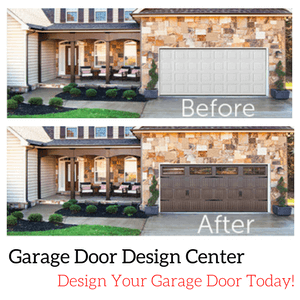
garage door design center
  • 1205 S Gillette Ave, Tulsa, Oklahoma, 74104
  • 400 Vermont Ave #125, Oklahoma City, Oklahoma, 73108
Discount Garage Door
Residential Garage Doors, Commercial
Garage Doors, Garage Door Openers, Repair,
Overhead Door Repair, Garage Door Repair
Areas of Service
Oklahoma City, Edmond, Norman, Moore, Tulsa, Owasso, Yukon, Broken Arrow, Claremore, Central Oklahoma, Sapulpa, New Tulsa, Jenks, Glenpool, Prattville, Sand Springs, Leonard, Coweta, Kiefer, Oakhurst, Inola, Fair Oaks, Verdigris, Lotsee, Sperry, Justice, Valley Park, Bixby, Mannford, Cleveland, Westport, Prue, Bethany, Midwest City, Spencer, Newcastle, Harrah, Jones, Piedmont, Arcadia, Luther, Wellston, Dell City, Tuttle, Bridge Creek, Blanchard, Mustang, Noble, Goldsby

*Ask a technician for written warranty, lowest price guarantee, and a list of complete details. Restrictions Apply.